Which moves get posted, and which get you blamed
In part one we looked at how often reviewers agree. This part asks a more practical question: what kinds of incidents are people actually asking about, and does the kind of move change the verdict?
Posters rarely say what happened
Only 45% of threads name the move in the title or the post. The commenters name one in 73%. Most posts say "who's at fault?" and let the clip do the talking, so the best record of what an incident was is what the replies call it. We counted a move as present when the poster or a meaningful share of commenters mentioned it.
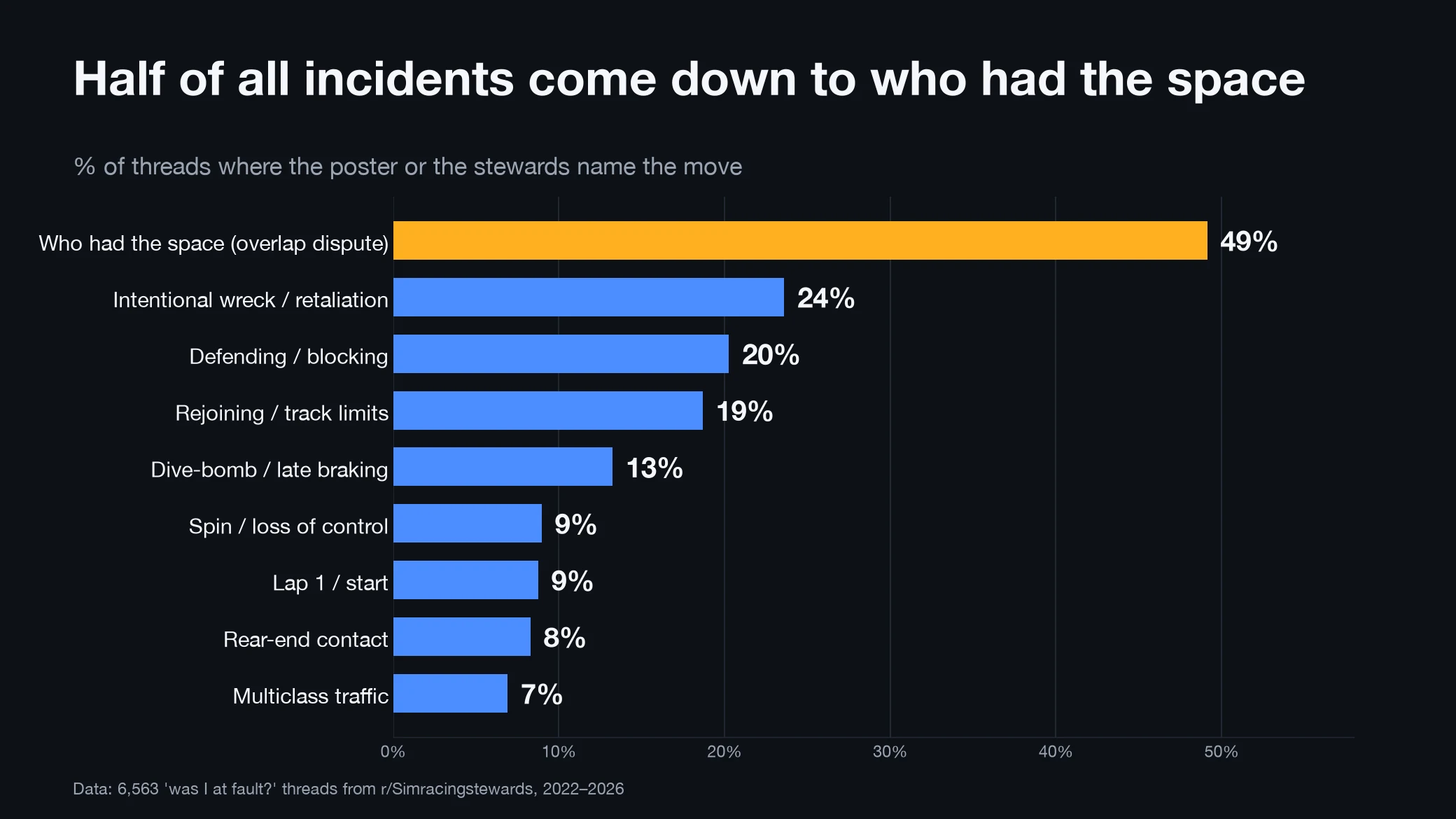 Share of threads that name each move. A thread can name more than one.
Three things stand out.
Half of everything is a dispute about space. 49% of threads turn on who had room, who was alongside, or who was pushed wide. It's a broad bucket, because that vocabulary shows up in almost any contact, but it tells you what the argument is usually about. Part three goes into it.
Intent comes up in a quarter of threads. 24% talk about intentional wrecks, retaliation, brake-testing or PIT manoeuvres. Often the answer is "no, that was a mistake", but the accusation is common enough that a league without a clear rule on intent is going to spend a lot of time on it.
The rest is a long tail. Defending or blocking (20%), rejoining and track limits (19%), dive-bombs and late braking (13%), spins, lap-one chaos and rear-end contact (8 to 9% each), then multiclass traffic (7%), netcode (4%), flags and restarts (3%) and pit lane (2%).
Which moves end with the poster blamed
Across all threads, 27% of verdicts blame the poster. By move it ranges from about 21% to 36%.
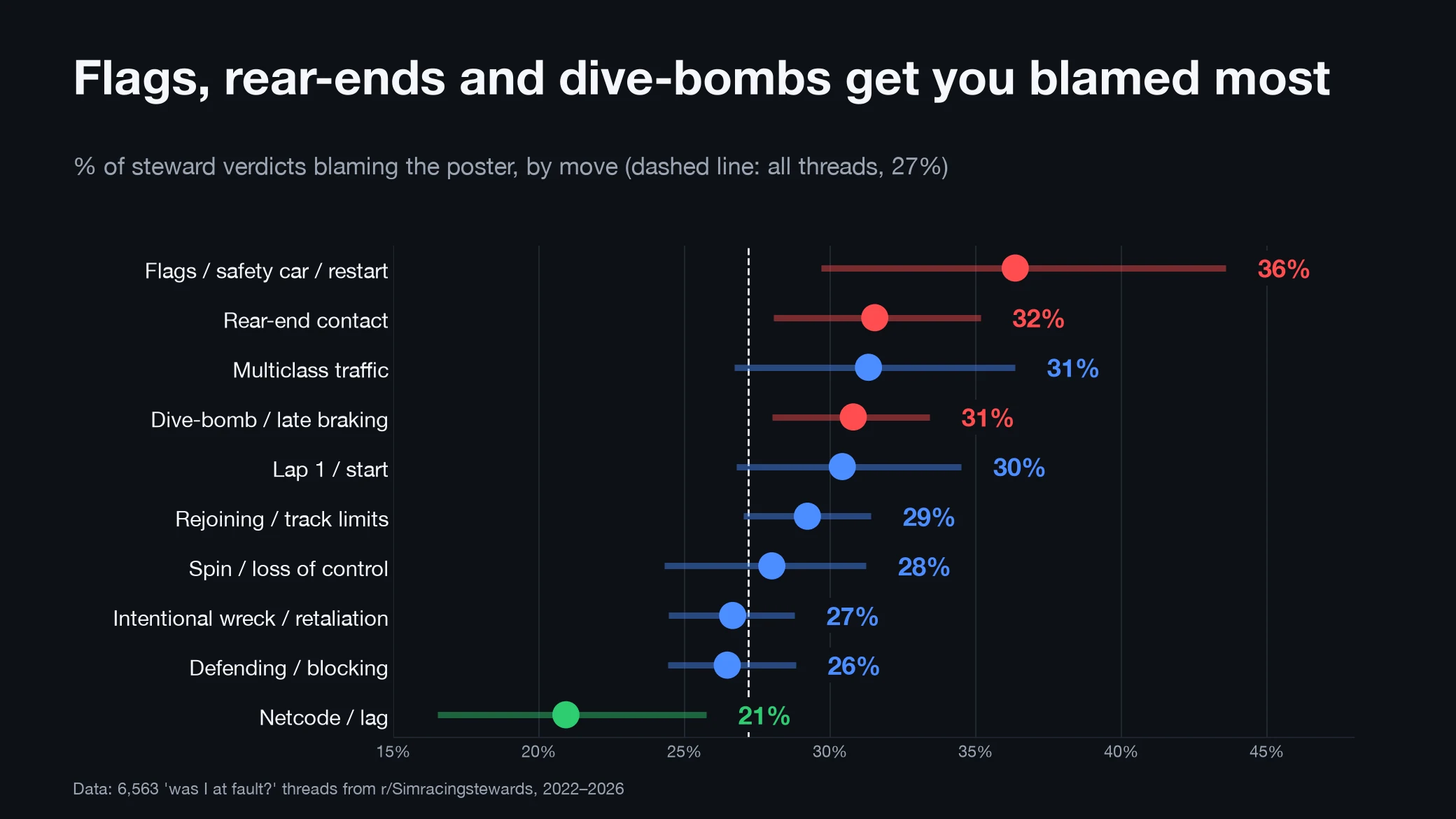 Share of verdicts that blame the poster, by move, with 95% confidence ranges. The dashed line is the all-thread average.
- Flags, safety car and restarts: 36%. The highest, though from a small number of threads, so the range is wide (30% to 44%).
- Rear-end contact: 32%. The default rule, that the car behind is responsible for avoiding the car in front, is doing its work.
- Dive-bombs and late braking: 31%. Attempting a pass that needs more room than exists is judged harshly, as most rulebooks intend.
- Lap-one incidents (30%) and multiclass traffic (31%) are a little above average.
- Defending (26%) and intent (27%) sit at the average.
- Netcode: 21%. The lowest. Whenever lag is a plausible explanation, commenters are less willing to blame the poster, which fits the point in our post on netcode that lag can make an incident look different from what happened.
The honest reading is that the differences are modest. No move is automatically the poster's fault, and none gets them off. The clip matters more than the label.
A trend that isn't one
Multiclass threads grew from 4% in 2023 to 11% in 2026, which looks like a story about more multiclass racing. It's mostly a story about which sim people post from: Le Mans Ultimate threads name multiclass traffic in 13% to 18% of cases, against 6% to 10% on iRacing, and LMU only started to show up in 2025. Within each sim the share is steady. We'll come back to that in part four.
What to do with it
For a league, the list is a to-do list for your rulebook. If half of incident threads depend on who had space, 24% on intent and a fifth each on defending and rejoining, those four topics should each have a definition written in plain language, with an example. Our guides on writing a ruleset and penalty guidelines are a starting point.
For a driver asking "was I at fault?", the useful move is to say what the incident was. A title like "Did I leave enough room on the outside at turn 3?" gets better answers than "who's at fault?", because the reviewers know what to look at.
A small note about us
Once your ruleset says what a late dive or an intentional wreck is, Sim Racing Steward applies that ruleset to each clip, and the steward report lists the relevant rules from it so you can check the reasoning. Sign up now and try one of your own incidents on the free plan.
Data: 6,563 first-person threads from r/Simracingstewards. Moves are tagged from keywords in the post and comments; in a hand check about 85% of tags were genuine. "Overlap dispute" is a deliberately broad category.